Maybe quality should be the goal (not a guardrail)
The premise in software right now is that we should be using AI to move faster. Whatever used to take three months should take two weeks. Whatever used to take two weeks, we should be able to do in a day. And the net effect of all this is that we should be able to deliver 10X the value (or more) that we could previously deliver in any period of time.
The familiar concern accompanying this desire to move faster is that we don’t want to just generate a ton of so-called “slop”. We don’t want to ship so fast that quality takes a nosedive. So the standard thinking is that we treat quality as a guardrail: we’ll monitor it and make sure it doesn’t go down. As long as throughput goes up and quality doesn’t tank, everyone’s happy.
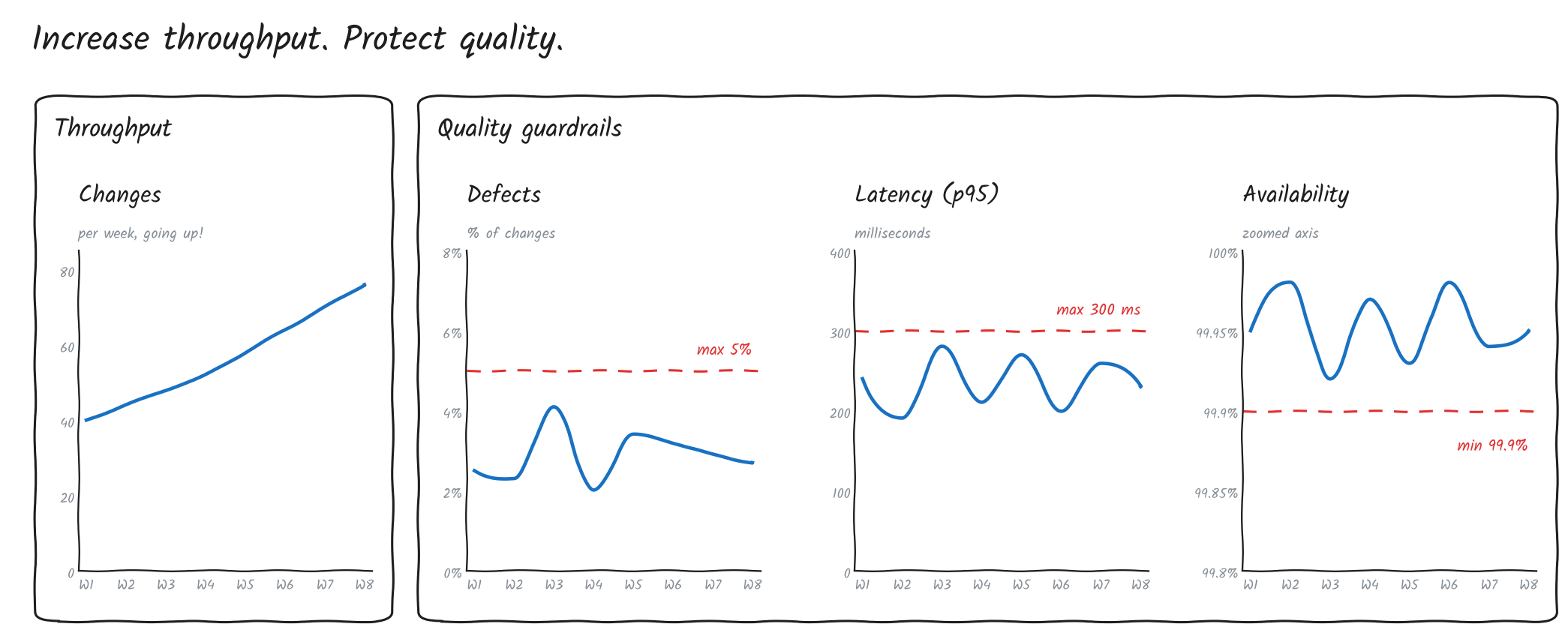
I am not so sure about this premise.
How much faster do we actually want to go?
To be clear, I do think we should be going faster. Our products could evolve faster than they do, and I think many of our customers would love for them to.
Many, not all. Some customers explicitly DON’T want things to move that fast; that’s why Atlassian has “release tracks” for enterprise customers, and why many other enterprise companies offer similar controls. So it’s already the case that delivering more, faster, isn’t necessarily for everyone.
But let’s accept that at least for most customers it would be nice to get new capabilities sooner, things that let them do what they couldn’t do before. How much do they want? If we shipped twice as many features in a year, would that be the sweet spot? What about 10X as many features? I don’t know what the limit is, but I’m quite confident there is one.
(Steve Yegge actually found the limit: at one point his agents were shipping so many features to his game that the players asked him to stop.)
Flip it around
So here’s my thought. What if instead of treating quality as a guardrail and throughput as the goal, we reversed it—made quality the goal, and throughput the guardrail?
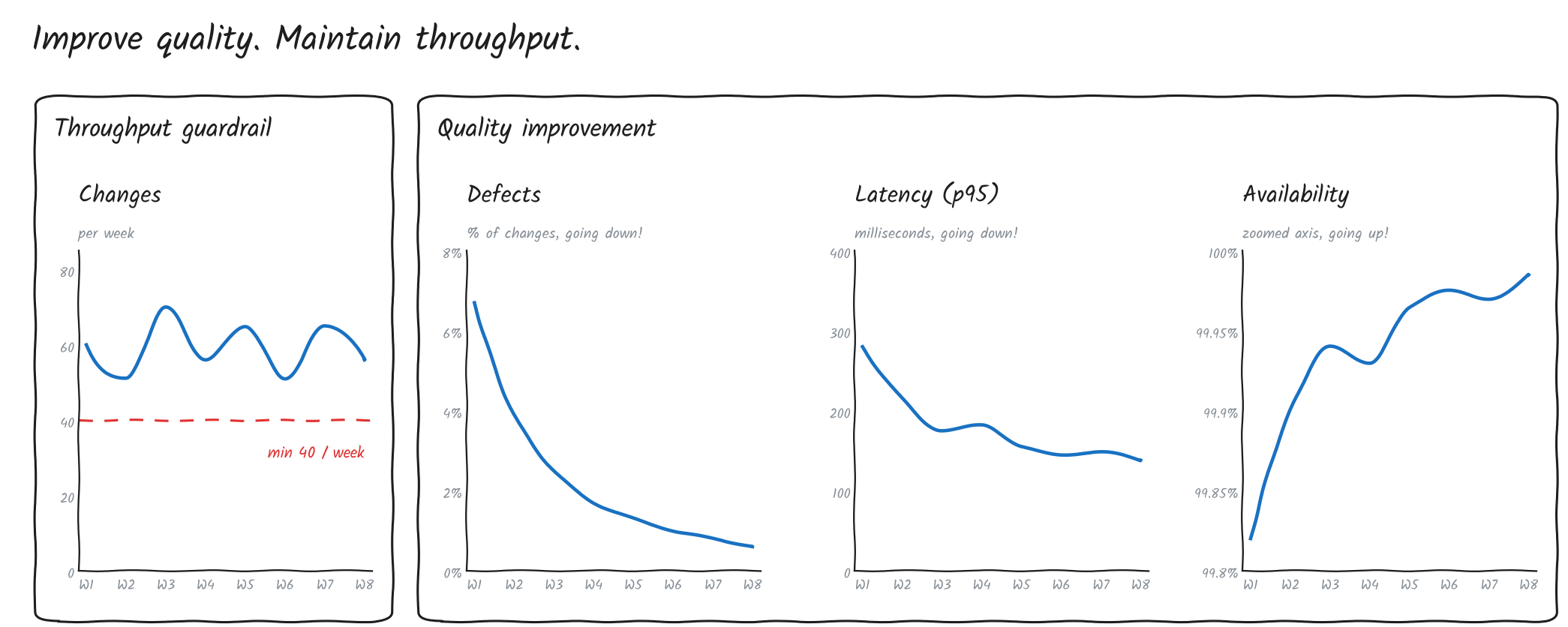
We certainly don’t want to slow down. I’d even say we should aim to at least double the rate at which we ship new features. But beyond that, what should we be doing with all of this untapped AI potential?
Personally, just looking at the industry as a whole, I would not rate most software products that exist today “A+ on quality”. Customers have a lot of valid complaints: many of the products they use are clunky, slow, buggy. And they’re unreliable; there are outages, periods of degraded performance, cybersecurity incidents. There is a lot of room for improvement.
Imagine if the products we use had all the same features they have today, but were lightning fast, extremely reliable, never went down, and were so well made that users essentially never ran into weird bugs. I think that would go a long way toward earning the trust of the people using these products. And it’s very different from where most of us are focusing our energy right now.
Until quality is uniformly excellent across our products, I think there’s a lot to be said for being more ambitious about driving it up. Shipping more features primarily serves the customers who have an appetite for more change. Improving quality indisputably benefits all of them.
Guardrails get demoted
There’s another problem with calling quality a guardrail, which is really a feature of guardrails in general. By designating something a guardrail, you’ve implicitly demoted it relative to whatever your real goal is.
If your real goal is throughput, then you will feel good when throughput goes up, and you will get frustrated when the guardrail stops you from achieving that. This is only natural. Eventually you’ll reach a point where you could get a lot more throughput in exchange for only a small dip in quality, and this will lead to an exchange-rate mentality: What if I could improve throughput by 10 and only hurt quality by 1? If throughput is what really matters, that seems like a great trade. Yes, quality matters, but only as a guardrail, so it doesn’t matter as much.
And that’s how a situation that was already not great starts going backwards.
I’m not saying anything groundbreaking here. I think this is exactly what we’re already seeing across the industry: outages are more common, defects are more common, and “slop” has become part of our vocabulary. To be fair, the models keep getting better, and maybe some of that problem will go away on its own. But better models won’t change what we’re choosing to prioritize, or where we’re putting our attention.
A couple of disclaimers
First, I’m talking about quality very loosely, and quality isn’t a well-defined thing. It’s one of those things we all recognize when we experience it, but none of us can define precisely.
For me, it boils down to making people’s lives better: giving them something to enjoy, helping them complete a task more effectively, giving them back some free time, solving a problem they have.
That’s impossible to track objectively, so in the charts above I didn’t use some abstract “quality” line. Instead I used metrics that are clearly correlated with quality: number of bugs, performance, availability. What these have in common is that they are measurable, and improving them benefits everyone. No customer is going to complain that we fixed too many bugs, made the product too fast, or kept it up too reliably.
Second, I don’t actually think either quality or throughput should be a guardrail in an absolute sense. As I’ve written before, what we should really be striving for is delivering the most value over time. That’s an optimization problem, where we aim to maximize the product of velocity and quality, not just maximize one while holding the other steady (the same way you don’t maximize the area of a rectangle by focusing only on length or width).
Pragmatically, though, I know a problem like this often becomes more tractable when you focus on one dimension at a time while guarding the other. If we’re going to pick one dimension to push on right now, quality may well be where the greater opportunity lies to help more people.